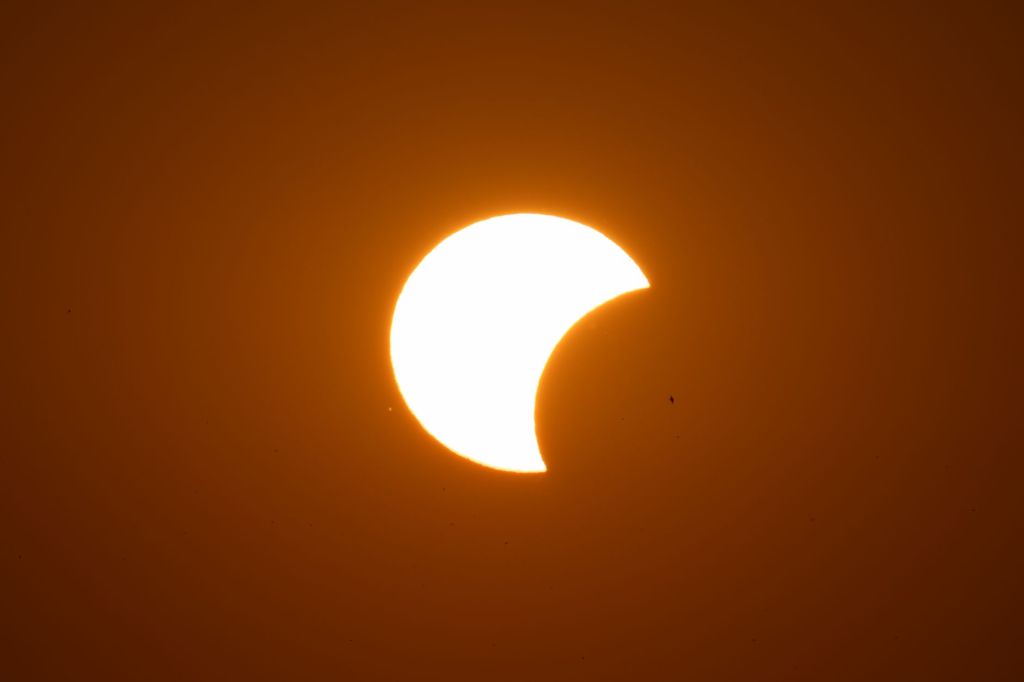
There are some days a town remembers by the weather, some by who got married or whose calf got loose, and a precious few by what happened in the sky. Monday, April 8, 2024, was one of those rare days in Lampasas, Texas. Right in the middle of an ordinary afternoon, the Moon moved in front of the Sun and daylight slipped away.
Lampasas sat close to the center of the eclipse’s path of totality, so this little Hill Country town had a front-row seat. The partial eclipse began shortly after noon, and by about 1:35 in the afternoon the Sun was completely covered. Astronomy magazine calculated 4 minutes and 24 seconds of totality for Lampasas. On its list of 20 recommended viewing places, Lampasas was the sixth stop overall and the third Texas location named. That is mighty fine company for a town most folks usually pass through on the way to somewhere else.
The change did not happen all at once. The light thinned and took on a strange, muted color. Then the temperature dropped. Day turned to twilight, and the bright ring of the Sun’s corona showed around the black circle of the Moon whenever the passing clouds allowed. Across eclipse country, birds quieted and bright planets and stars became visible in the daytime sky. Imagine looking up after lunch and seeing the heavens behaving like midnight had come early.
Folks gathered in Lampasas parks and open spaces, wearing their eclipse glasses and watching the clouds as closely as the clock. Local reports said two city parks filled up, and the town had prepared carefully for the visitors. For those few minutes, people who had come from near and far all stood under the same shadow. Some cheered. Some went quiet. I expect more than a few simply stared, because there are moments too big for talking.
Lampasas does have a way of finding itself in the middle of unusual history. Back in 1952, more than 100,000 military personnel came through Central Texas for Operation Longhorn, a massive war game in which mock enemy forces occupied Lampasas before United States troops took it back. Decades later, another great event rolled through—only this time the visitor was the Moon’s shadow, and the whole town welcomed it.
And because this is Texas, Lampasas also has a roadside landmark big enough to match the story: the World’s Largest Spur. The Guinness-recognized metal sculpture stands about 34 feet tall. It seems fitting that a place with a giant spur would also get a Texas-sized view of the sky.
The next total solar eclipse visible anywhere in the contiguous United States arrives in 2044, but its path of totality will stay far north of Texas. A small part of the Texas Panhandle is due to return to totality in 2045. For Lampasas, the wait will be much longer. That makes those four minutes and 24 seconds feel even more precious.
What stays with me most is not only that the Sun disappeared. It is that a whole town stopped what it was doing and looked up together. For one little stretch of an April afternoon, everybody stood beneath the same darkened sky and remembered how small we are—and how beautiful this old world can be.
Where were you when the Sun went out on April 8, 2024? Tell me what the light, the quiet, and that sudden darkness felt like where you stood.
Sources
• Astronomy magazine: “20 of the best places to view the 2024 total solar eclipse” [link]
• City of Lampasas eclipse planning information [link]
• KWTX: Central Texans after eclipse totality [link]
• Eclipse photograph source page [link]
• City of Lampasas: World’s Largest Spur [link]
• Operation Longhorn historical-marker text [link]

